

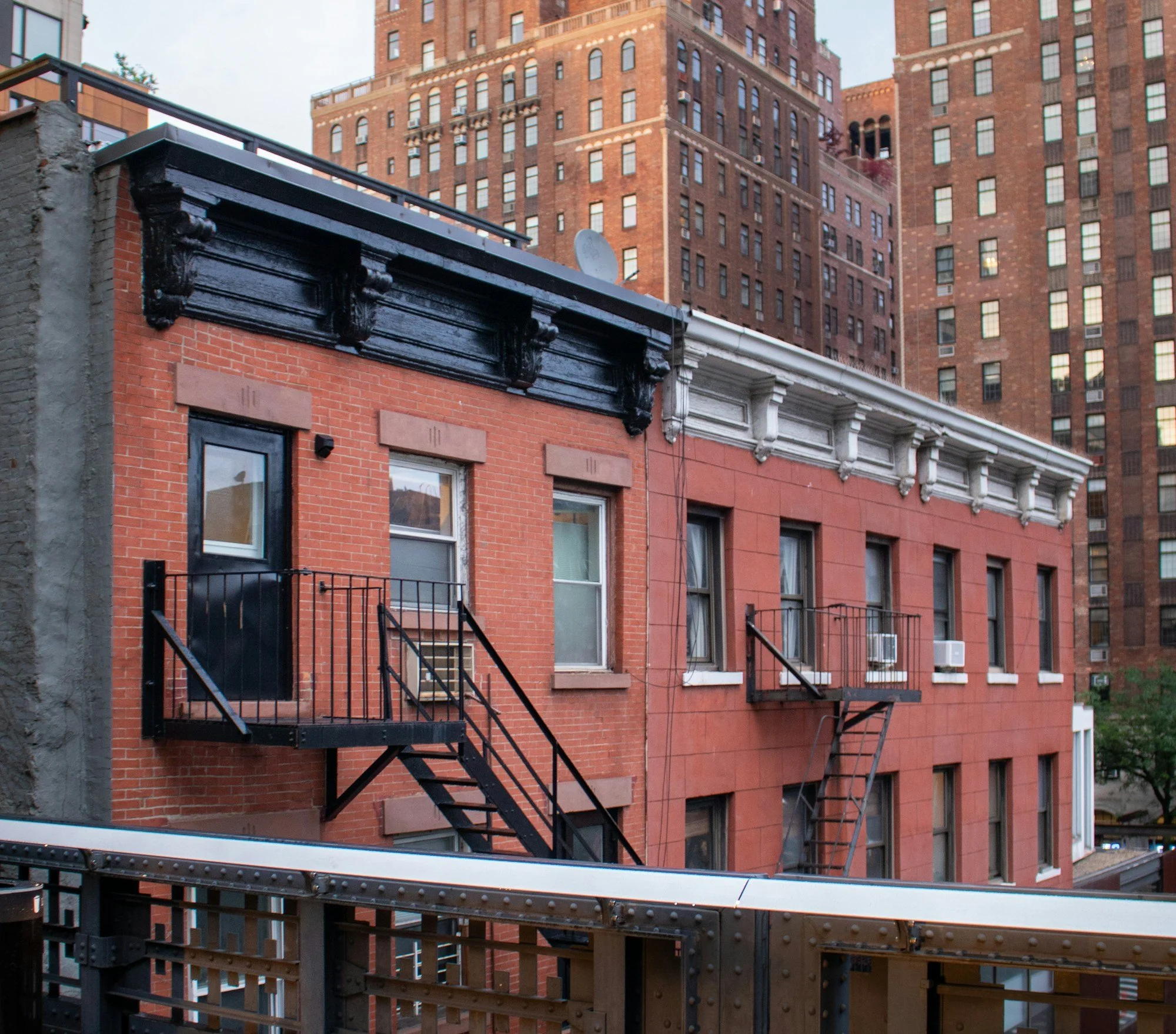
A Chelsea loft is one of the nicest spaces in Manhattan to paint and one of the easiest to get wrong. The walls are tall, the room runs from the windows to the kitchen without a door in between, and the light coming off the street or the High Line shows every flaw. Then there's the building itself: a converted warehouse with a freight elevator, a management office with rules, and neighbors who don't want to hear ladders in the hallway at 7 a.m.
This post is about how the work actually gets done in a space like that. If you want to know what a Chelsea job costs and why, start with our Chelsea guide to layout, prep and painting costs. If you're measuring a big loft for a quote, our Tribeca post on wall area and ceiling height walks through it. Here we're talking about execution: equipment, sequence, where the color stops, and getting in and out of the building.
Why Chelsea lofts are their own kind of job
West Chelsea has a lot of former industrial buildings. The Landmarks Preservation Commission designated the West Chelsea Historic District on July 15, 2008. According to a City Planning Commission report, it covers about 30 industrial buildings built between 1885 and 1930. Not every loft is in a landmark district, but many of them share the same bones: tall ceilings, big windows, concrete or heavy timber, and floor plates that were built for goods, not living rooms.
When those buildings became apartments, a lot of the open space stayed open. That's great to live in. For painting, it means three things change compared with a typical apartment:
Height. Walls and ceilings are out of reach from a normal stepladder.
No natural breaks. There are fewer corners and doors where one day's work can end and the next can start.
Access. Everything comes in through a freight elevator or a loading entrance, on the building's schedule.
Tall walls: the right equipment for the height
On an 8- or 9-foot ceiling, a painter works from the floor with an extension pole and from a short stepladder for cutting in. In a loft with a 12- or 14-foot ceiling, that setup stops working, and the equipment choice affects safety, speed and finish quality.
Here is what we usually bring, depending on height:
Extension poles for rolling walls and ceilings from the floor. A pole keeps the painter on the ground for most of the rolling, which is faster and safer than climbing.
Taller stepladders for cutting in the ceiling line, around beams, and at the tops of windows.
A rolling scaffold (often called a baker's scaffold) for long runs of ceiling line, beams, ductwork, or tall window walls. It's a work platform you can move along the wall instead of moving a ladder every few feet.
Extension ladders only where there's something solid to lean on, like a stair opening or a mezzanine wall.
What the safety rules say
Your painters, not you, are responsible for following safety rules, but it helps to know what good practice looks like. A few points from OSHA's construction standards:
Stepladders. OSHA's ladder rule, 29 CFR 1926.1053, says the top or top step of a stepladder shall not be used as a step. Ladders go only on stable, level surfaces unless they are secured, and not on slippery surfaces unless they are secured or have slip-resistant feet. Polished concrete counts.
Leaning ladders. The same rule sets the angle: the foot of the ladder should be about one-quarter of the working length away from the top support.
Rolling scaffolds. OSHA's rule for specific scaffold types, 29 CFR 1926.452, says casters and wheels must be locked while the scaffold is used in place. Nobody rides a moving scaffold unless the floor is within 3 degrees of level and free of holes and obstructions, and the scaffold is no more than twice as tall as it is wide during the move, unless it's built to meet recognized stability tests.
Height. Under the general scaffold rule, 29 CFR 1926.451, a supported scaffold taller than four times its base width has to be restrained from tipping, and a worker on a scaffold more than 10 feet above a lower level must be protected from falling. Platforms on working levels have to be fully planked or decked.
What this means for you: if a crew shows up to a 14-foot ceiling with one 6-foot stepladder and plans to stand on the top, that's a problem, and it usually means the finish won't be great either. Ask what equipment they plan to bring when you get the quote. A real answer names it.
Protecting the floor under the equipment
Loft floors are often the most valuable surface in the room: refinished wide-plank wood, polished concrete, or epoxy. A rolling scaffold puts its whole load on four small wheels. We put heavy drop cloths or floor protection board down along the scaffold path, and we keep the casters clean so grit doesn't get dragged across the floor. If your floor was just refinished, tell us how long ago. Fresh finishes can be soft for a while, and tape or protection board on them can leave marks.
Ceiling first, then walls
In a tall space we almost always paint top-down: ceiling, then the ceiling line, then the walls, then trim and doors. Paint drips and spatter fall down, so anything done above should be done before what's below it.
A dedicated ceiling paint helps here. Benjamin Moore's Waterborne Ceiling Paint, for example, is an ultra-flat acrylic that the company says is made for minimal spatter and has enough open time to avoid lap marks (Benjamin Moore technical data sheet). It can be recoated in one to two hours, so on a typical ceiling we can usually get both coats on in a day and move the scaffold out of the way before starting the walls.
Exposed ductwork, sprinkler pipes and beams change the plan. Each one is its own small job with brushes and a lot of masking. We also keep paint off sprinkler heads. If you have exposed systems, point them out during the walk-through so they're in the quote.
Long walls without lap marks
A wall that runs 30 feet with no corner has to be rolled in one continuous push from one end to the other. If the paint at the start of the wall dries before the crew gets back to it, you get a visible stripe. Our SoHo post on brick, beams and large walls covers the wet-edge technique and why flat paint hides more than eggshell under side light.
On the day itself, it comes down to planning:
Enough people on the wall. On a tall, long wall, one painter cuts in the top while another rolls right behind them. If the crew is too small, the cut line dries before the roller gets there and shows as a frame around the wall.
No breaks mid-wall. A crew should finish a wall before lunch, not halfway through.
Watch the windows. Sun across a wall speeds up drying. On a bright afternoon we may start the west-facing wall early and do it when it's out of direct sun.
Check under raking light. Before the scaffold leaves, we look at the wall from the side, with the light coming across it. That's when missed spots and patches show up, and it's much easier to fix them before the equipment is gone.
Open plans: where does the color stop
In a room with doors and corners, color decisions are easy. Each room gets a color, and the color stops at the corner or the door casing. In an open loft, where living, dining and kitchen are one space, there may be no obvious place to stop.
Here is how we usually help clients decide:
Stop at an inside corner, not an outside corner. An outside corner gets bumped and is very hard to cut cleanly. An inside corner hides a color change best.
Use the architecture. A column, a soffit, a beam line, a change in ceiling height, or the edge of a kitchen wall all make natural breaks.
Don't float a color line in the middle of a wall. Unless you want a deliberate block of color, a line in open space tends to look like a mistake.
Treat the ceiling as one surface. In a big room, one ceiling color all the way across keeps the space calm, even when the walls change.
If you're thinking about an accent wall, test it on site at full height. A sample card held at eye level doesn't tell you what a 14-foot wall looks like in afternoon light. For whites in particular, NYC Painters has a useful guide to gallery whites for Chelsea apartments and lofts.
Living in the loft while we paint
The hardest part of an open plan for the people who live there is that there's no room to close off. In a regular apartment, we can paint the bedroom while you live in the living room. In a loft, the bedroom may be a sleeping area behind a half wall.
What usually works:
Paint in zones. We move the furniture to one half of the space, paint the other half, then swap. In a large loft, that may mean the job runs a day or two longer than if it were empty, but you can stay.
Plan the kitchen day. If the kitchen is part of the open area, there will be a day when it's masked off. We tell you in advance which day.
Ventilation. The EPA's guidance on VOCs and indoor air quality lists paints as a common source and advises increasing ventilation when using products that emit VOCs. Big loft windows help, and low-odor paints make a real difference when you're sleeping in the same room you're painting.
Pets and kids. An open space with wet paint and a scaffold is not a place for a dog or a toddler to wander. Plan where they'll be.
If you'd rather be out of the apartment for a few days, the job will go faster and cost a little less in labor. Either way works. We just need to know before we schedule.
Access: freight elevators and building rules
Most Chelsea loft buildings have a freight or service elevator, and almost all of them have rules about using it. Building access is usually where a loft job gets held up, not the painting.
Before the job starts, find out:
When the freight elevator runs. Many buildings limit it to weekday business hours, and some require a reservation.
Whether it fits. A scaffold breaks down into frames and planks, but a 16-foot plank or a tall ladder won't fit in a small passenger elevator. If there's no freight elevator, tell us, so we bring equipment that will fit.
What the building needs on paper. Most managed buildings want a certificate of insurance before contractors can come in, often naming the building, the managing agent, and sometimes the board. Our Upper East Side co-op post explains how the paperwork, hall protection and work hours usually go.
Where we can stage. Some buildings let us leave equipment overnight in the apartment, others want the hallway clear every evening. Overnight storage in the unit saves a lot of setup time on a multi-day job.
Loading and parking. West Chelsea streets are busy, and some buildings have a loading dock with its own schedule. Knowing where we can unload saves time on the first and last day.
If your loft is in an older converted building, also mention any known history of lead paint on windows, trim or radiators. Disturbing old painted surfaces in pre-1978 housing comes with lead-safe work rules under the EPA's Renovation, Repair and Painting program and the city's safe work practices, and they shape how we prep those areas.
What a good loft quote spells out
For a tall, open space, a useful quote doesn't just say "paint walls and ceilings." It should list:
Surfaces and heights, including beams, ductwork, soffits and tall window walls.
Equipment, such as a rolling scaffold, and who brings and removes it.
Sequence and zones, especially if you're living there.
Where each color starts and stops, in writing or on a simple plan.
Floor protection under the equipment, by type of floor.
Building logistics, such as freight elevator times, the insurance certificate, and staging.
For a sense of the overall numbers before anyone visits, the NYC apartment painting cost calculator lets you plug in rooms, ceilings and condition. NJ Painters makes a useful point in its interior painting cost guide: high-ceiling rooms can double the labor on a single space, because of the extra setup and slower work up high. Lofts in Manhattan work the same way. Our NYC apartment painting cost guide has the broader price picture.
Getting it planned
A Chelsea loft paints beautifully when the equipment matches the height, the crew is big enough for the walls, the color breaks are decided before anyone opens a can, and the building knows we're coming. Most of that is settled at the walk-through.
If you're planning a loft repaint in Chelsea, request an estimate or read more about our apartment painting work in Manhattan. Have your ceiling height, your building's contractor rules and your rough color ideas ready, and we'll take it from there.