
When someone on the Upper West Side asks us what it costs to paint their apartment, we usually answer with a question: which parts? A painting quote is really three jobs stacked together. Walls, ceilings, and trim are measured differently, take different paint, and move at different speeds. Lump them into one number and you can't tell where your money is going, or which part you could put off.
This post breaks those three apart. If you want the big picture first, including survey numbers for whole apartments, start with our guide to what it costs to paint a Manhattan apartment. Here we go one level down: surface by surface.
How painters measure each surface
Most of the confusion in painting quotes comes from units. Each surface has its own.
Walls are priced by wall area, not floor area. A 12-by-12 room has roughly 350 to 400 square feet of wall once you subtract doors and windows. That is about two and a half times the floor area (NYC Painters cost calculator). If a painter quotes a per-square-foot price, ask which square feet they mean.
Ceilings are priced by ceiling area, which is close to the room's floor area. Some painters quote a separate per-square-foot rate. Others add a percentage on top of the wall price. The NYC Painters apartment painting cost calculator uses a 20% allowance on the wall cost for ceilings.
Trim is priced by the linear foot or by the piece. Baseboards, crown molding, and chair rails are usually measured in running feet. Doors, door casings, and windows are usually counted one by one. The same calculator uses a 15% allowance on the wall cost for trim, plus $100 to $200 per door and $75 to $150 per closet. Those are budgeting allowances, not quoted rates. The calculator page says so itself.
Once you know the units, you can check a quote line by line instead of arguing with a total.
What national cost data says about each surface
National numbers won't tell you what a Manhattan job costs. They do show you how the industry splits these surfaces. All of the figures below are national averages, not Upper West Side quotes.
Walls. The wall rate most NYC painters start from is roughly $2 to $6.50 per square foot of wall, depending on condition and paint choice (NYC Painters cost calculator).
Ceilings. Angi puts ceiling painting at $0.50 to $5 per square foot overall, and $0.50 to $3 for a smooth, flat ceiling. Skim coating a damaged ceiling runs $1.10 to $1.30 per square foot, and larger ceiling repairs $440 to $1,500. Angi also says some painters don't charge extra for 10-foot ceilings, but you should expect $100 to $500 more for ceilings higher than that (Angi ceiling painting costs).
Trim. HomeGuide lists interior baseboards at $1 to $4 per linear foot and crown molding at $1 to $5. It prices a door with its trim at $40 to $125 per side, and an interior window frame at $25 to $100. The price rises to $50 to $120 per window once the sash and mullions are included (HomeGuide trim painting costs). Angi's trim ranges are similar: $1 to $5 per linear foot for baseboards and crown, and $1 to $4 for doors, windows, and chair rails (Angi trim painting costs).
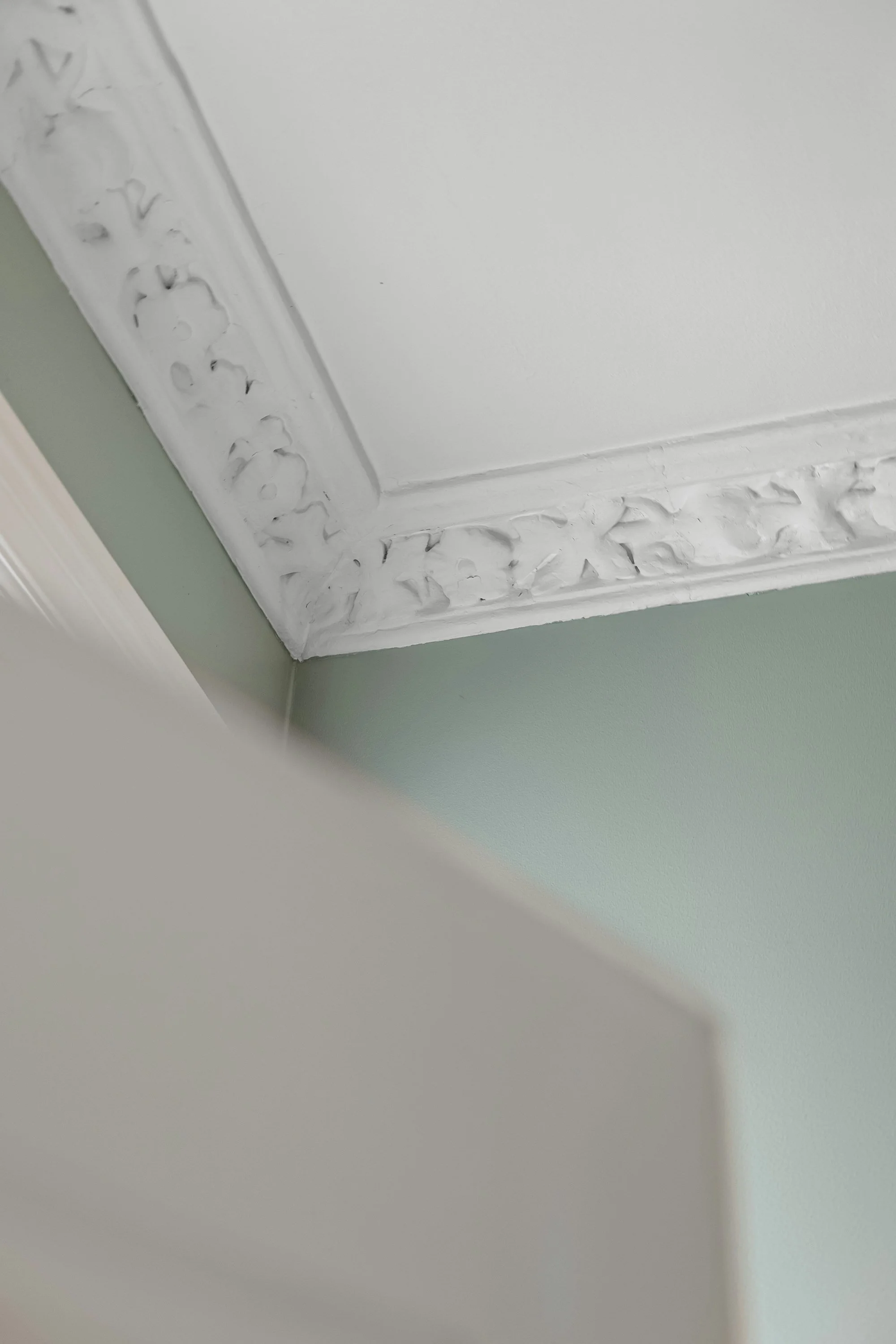
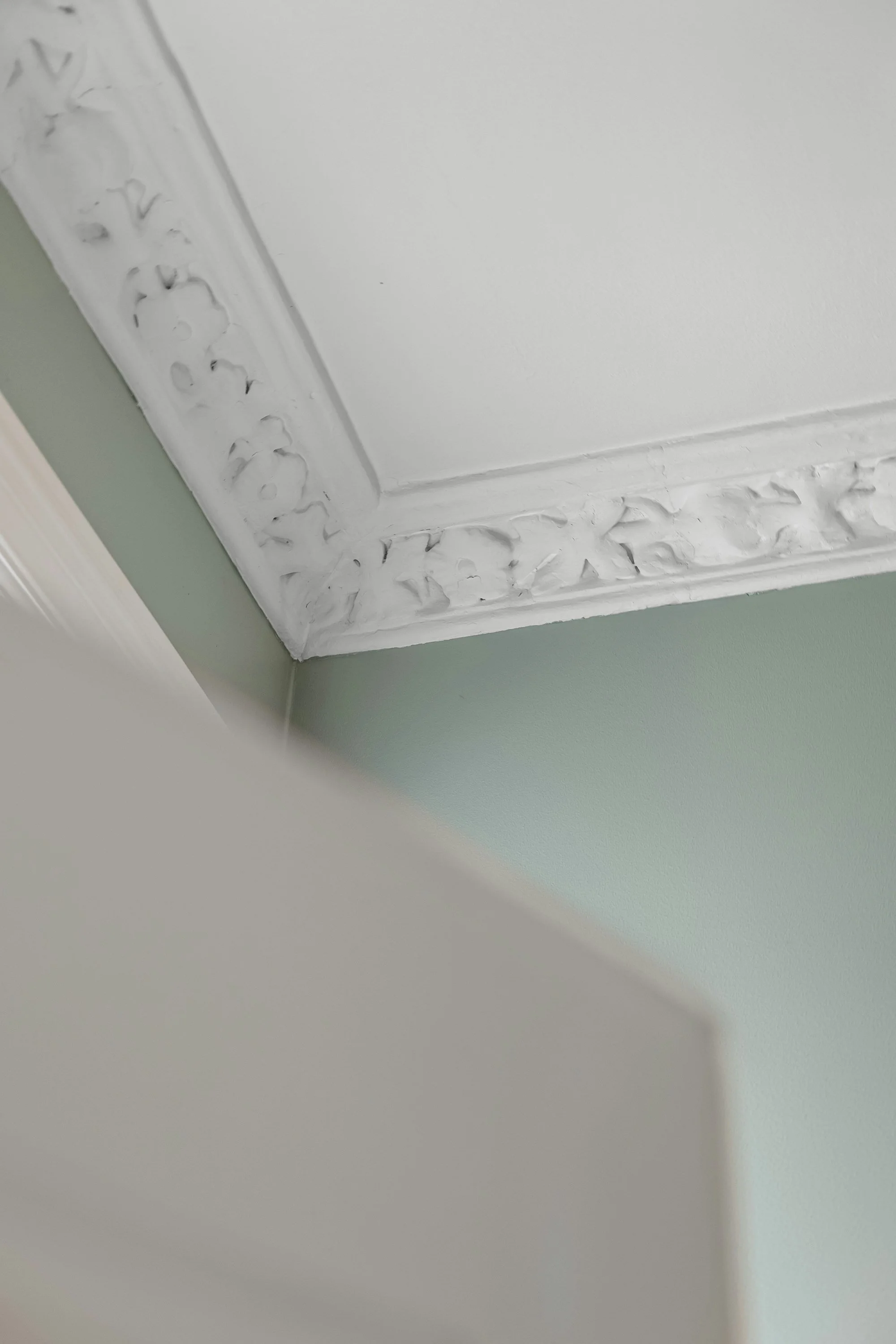
Notice what those trim numbers do to an older apartment. A modern box has baseboards and flat casings. A turn-of-the-century apartment might have crown molding, picture rail, deep window casings, paneled doors, and a few divided-light windows. Every one of those is a separate line, and every one is priced by length or by piece. That is why two apartments with the same floor plan can get very different trim quotes.
Walls: where prep decides the price
On walls, paint is the cheap part. Labor is mostly prep: patching, sanding, spot-priming, and caulking the joint where wall meets trim. A wall in good shape takes a light patch and two coats. A plaster wall with old cracks, bulges, or years of patch-over-patch needs more before paint touches it.
When you read a wall quote, look for three things:
How many coats. Same-color refreshes often take two. A big color change, especially dark to light, can take a tinted primer plus two finish coats.
What repairs are included. "Minor patching" should be defined. Cracks that come back every winter are a plaster problem, not a paint problem, and should be priced separately.
Ceiling height. Wall area grows with height. A 10-foot ceiling means about 25% more wall than the same room at 8 feet (NYC Painters cost calculator). Measure your own ceilings before you compare quotes.
If you're still choosing colors, NYC Painters has a guide to Upper West Side apartment colors for classic doorman buildings. Color affects cost too, because it decides the coat count.
Ceilings: easy to skip, expensive to get wrong
Ceilings are the surface people most often leave out, and sometimes that's the right call. A ceiling that is clean, sound, and already flat white may not need anything. Look at it in daylight before you add it to the scope.
When a ceiling does need paint, three things drive the cost.
Height and access. Above 10 feet, painters need taller ladders or planks, and every move of that equipment is time. Angi's $100 to $500 range for ceilings over 10 feet reflects that labor (Angi).
Condition. Hairline cracks, water stains, and peeling are common in older plaster ceilings. A stain from an old leak needs a stain-blocking primer, or it will show through the new paint. Peeling has to be scraped back to sound paint first. If your building went up before 1978, read the lead section below before anyone scrapes anything.
The paint itself. A dedicated ceiling paint is built for working overhead. Benjamin Moore's Waterborne Ceiling Paint is an ultra-flat acrylic. The company says it covers 400 to 450 square feet per gallon, is formulated for minimal spatter, and has enough open time to avoid lap marks. It can be recoated in one to two hours (Benjamin Moore technical data sheet). Fast recoat time means a crew can usually get two ceiling coats done in a day. That keeps the ceiling line on your quote under control.
Here is a sequencing point people miss: ceilings go first. If you paint the walls now and the ceiling next year, the painter has to cut a clean line against finished walls and protect them while working overhead. Doing both in one visit is almost always cheaper than two visits.
Trim: the slowest surface in the apartment
Trim is where time goes. It's detail work with a brush, the paint is harder, and it dries more slowly.
Drying time sets the schedule. Many painters use a waterborne alkyd on trim and doors because it levels out smooth and dries hard. Benjamin Moore's Advance, for example, is dry to the touch in four to six hours but needs 16 hours before a second coat. It takes five to seven days before it should take heavy wear, and up to 30 days to reach full hardness and final sheen (Benjamin Moore Advance technical data sheet). Two coats of trim paint means at least two days on site, even in a small apartment. Be careful with doors and window sashes for the first week.
Old oil paint needs extra prep. Many older apartments have decades of oil-based enamel on the trim. Latex paint can go over it, but only after proper prep. Sherwin-Williams lists two routes: wash, sand, and remove the dust before painting, or wash and apply an adhesion primer before the topcoat (Sherwin-Williams surface preparation FAQ). Benjamin Moore's instructions for Advance also say glossy alkyds should be sanded first (Benjamin Moore). Skip this step and the new paint can peel off in sheets. If a quote doesn't mention how old oil trim will be prepped, ask.
Ornate molding takes longer. Plaster crown molding with leaves, egg-and-dart, or dentil detail can't be rolled. It has to be brushed, and paint has to be kept out of the recesses so the detail stays sharp. On molding already clogged with old paint, the real question is whether to strip some of it, which is a separate and bigger job. Get that priced as its own line.
Windows and doors are counted by the piece. That is why HomeGuide prices them per side or per window rather than per foot (HomeGuide). A divided-light window with several panes takes much longer than a single sheet of glass. Count your doors and windows before you compare quotes, so you can check whether each painter counted the same number.
Lead paint: why trim and windows need special care
Trim, doors, and windows are the surfaces most likely to be scraped and sanded during a repaint. In older buildings they also tend to carry the oldest layers of paint.
Federal rule. In homes built before 1978, anyone paid to do work that disturbs paint generally has to be EPA-certified and follow lead-safe work practices. Jobs that disturb six square feet or less of paint per room inside are excluded from those practices, but window replacement is always covered, regardless of size (U.S. EPA).
Banned methods. On these jobs, federal rules ban torching painted surfaces. Power sanders and grinders are banned unless they have a shroud and a HEPA vacuum attachment, and heat guns must stay below 1,100°F (40 CFR 745.85). So if a quote involves stripping old paint off trim, ask how it will be done.
City guidance. New York City's housing agency advises lead-safe work practices in pre-1978 buildings when work disturbs 2 square feet or more of paint in a room. It also sets stricter rules where a child under 6 routinely spends 10 or more hours a week (NYC HPD safe work practices).
If you rent the apartment out. In buildings put up before 1960, the city requires owners to presume the paint is lead-based unless it has been tested and exempted. When an apartment becomes vacant, the city requires lead-based paint to be removed from doors and windows (NYC HPD lead-based paint).
Lead-safe work adds setup, plastic, wet methods, and HEPA cleanup. An honest quote shows that cost instead of hiding it. A quote that leaves it out on a pre-1978 trim job isn't really cheaper. It is quoting a different job.
Landmarked buildings: does painting need approval?
A large stretch of the neighborhood sits inside the Upper West Side/Central Park West Historic District, which the Landmarks Preservation Commission designated on April 24, 1990 (LPC district map). People living in landmarked buildings sometimes worry that they need permission to paint inside.
Usually you don't. The LPC says a permit for interior work is needed only in three cases: when the work needs a Buildings Department permit, when interior work affects the exterior, or when the interior itself is a designated interior landmark (NYC LPC permits). The Buildings Department, for its part, says painting doesn't need a permit (NYC DOB). If your plans touch anything seen from the street, such as window frames, call the LPC at 212-669-7817 before you start. Your co-op or condo board will still have its own paperwork, so ask the managing agent for the alteration and insurance requirements early.
Putting it together: a worked example
Here is how the allowances in the NYC Painters cost calculator stack up for a sample one-bedroom. This is arithmetic to show how the pieces add up. It is not a quote, and real numbers depend on condition.
Walls. A typical one-bedroom has about 1,000 square feet of wall at 8-foot ceilings. With 10-foot ceilings, that becomes about 1,250 square feet (1,000 × 10 ÷ 8). At $2 to $6.50 per square foot, walls come to about $2,500 to $8,125.
Ceilings. A 20% allowance on the wall cost adds about $500 to $1,625.
Trim. A 15% allowance adds about $375 to $1,219.
Doors. Six doors at $100 to $200 each add $600 to $1,200.
That gives a range of roughly $3,975 to $12,169 before sales tax. The combined New York City sales tax rate is 8.875% (New York State Publication 718), so ask each painter whether tax is included. The wide spread is the point. Condition, coat count, and how much trim you have decide where in that range your apartment lands.
How to scope a job you can afford
If the full number is more than you want to spend, split the job by surface instead of cutting corners on prep.
Walls now, trim later. If the trim is sound, a wall-only job is the biggest visual change for the money.
Trim-only refresh. If the walls are fine but baseboards and doors are scuffed, a trim-only job is a real option. Just plan around that 16-hour recoat time.
Skip the ceilings that don't need it. Look at each one in daylight. Paint only the ones that are stained, cracked, or yellowed.
Don't split ceilings from walls if both need it. Painting the ceiling after the walls are finished costs more than doing them together.
Get every surface itemized. Ask for walls, ceilings, trim, doors, and windows as separate lines, with coat counts and repair notes. Then you can compare quotes and decide what to cut.
When you're ready for a number for your own apartment, request a free estimate. We'll walk the apartment with you and price walls, ceilings, and trim as separate lines, so you can see exactly what each one costs.